HSK 2

Lesson 3 · 我想去西安旅游

What you'll learn

Ask reasons and travel plans, use result complements for outcomes, and use verb reduplication for short or tentative actions.
About 31 min
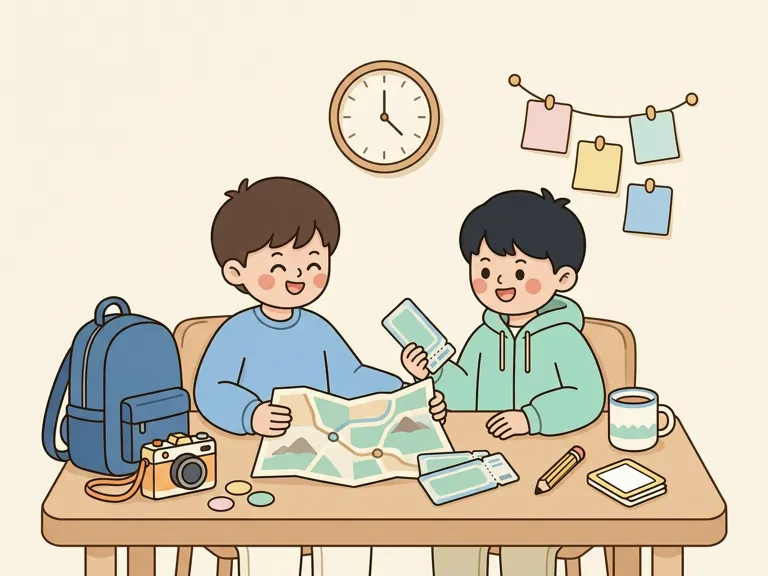
Two students at a desk looking at a blank travel map and discussing a trip to Xi’an.
1

Listen and Read

Talk about travel plans after work while practicing result complements and verb reduplication.

小林
你今天怎么回来这么晚?
Nǐ jīn tiān zěn me huí lái zhè me wǎn?
Why did you come back so late today?
小雨
工作太多,我已经做完了。
Gōng zuò tài duō, wǒ yǐ jīng zuò wán le.
There was too much work. I have already finished it.
小林
那先喝杯水,休息一下吧。
Nà xiān hē bēi shuǐ, xiū xi yí xià ba.
Then drink some water first and take a short rest.
小雨
谢谢。我想找时间去西安旅游。
Xiè xiè. Wǒ xiǎng zhǎo shí jiān qù Xī'ān lǚ yóu.
Thanks. I want to find time to travel to Xi’an.
小林
好啊,我们晚上想想去哪儿玩。
Hǎo a, wǒ men wǎn shàng xiǎng xiǎng qù nǎr wán.
Good. Tonight we can think a bit about where to go.
2

Core Words

These words support the dialogue, grammar, and practice in this lesson.

旅游
lǚ yóu
to travel
西安
Xī'ān
Xi’an
做完
zuò wán
to finish doing
看懂
kàn dǒng
to understand by reading
休息
xiū xi
to rest
3

Core Words

Recognize these for context; they are not the main practice focus.

to wash
不错
bú cuò
not bad; pretty good
sòng
to send; to give
4

Learning Note

Use `洗` in phrases like `洗衣服` and `洗手`. `不错` means pretty good. `送` is used in phrases like `送朋友回家`.

5

Learning Note

In `你今天怎么回来这么晚?`, `怎么` asks for the reason, not the method. It is close to `为什么`, and the answer can give the reason directly.

6

Pattern: `动词 + 完/好/懂/错`

动词 + 完/好/懂/错

A result complement comes after the verb and shows whether the action reached a result. Use `没` for the negative form.

我还没看懂这本书。
Wǒ hái méi kàn dǒng zhè běn shū.
I still have not understood this book.
晚饭已经做好了。
Wǎn fàn yǐ jīng zuò hǎo le.
Dinner is already ready.
7

Pattern: `看看 / 想想 / 休息休息`

看看 / 想想 / 休息休息

Reduplicating a verb can make the action sound short, light, or like trying it briefly.

你先看看这个地图。
Nǐ xiān kàn kàn zhè ge dì tú.
Take a quick look at this map first.
我们想想明天去哪儿。
Wǒ men xiǎng xiǎng míng tiān qù nǎr.
Let’s think a bit about where to go tomorrow.
8

Quick Practice

Choose the correct position for the result complement.

Which sentence means `I still have not understood this book.`

I still have not understood this book.

9

Quick Practice

Recognize `怎么` when it asks for a reason.

Your friend came home very early today. Which sentence naturally asks for the reason?

Why did you come home so early today?

10

Quick Practice

Recognize verb reduplication.

Which sentence means `Let us think for a moment.`

Let’s think for a moment.