HSK 2

Lesson 1 · 她请我们吃了北京烤鸭

What you'll learn

Use `请`, `让`, and `叫` for requests and arrangements, and use sentence-final `吧` to make a soft guess.
About 30 min
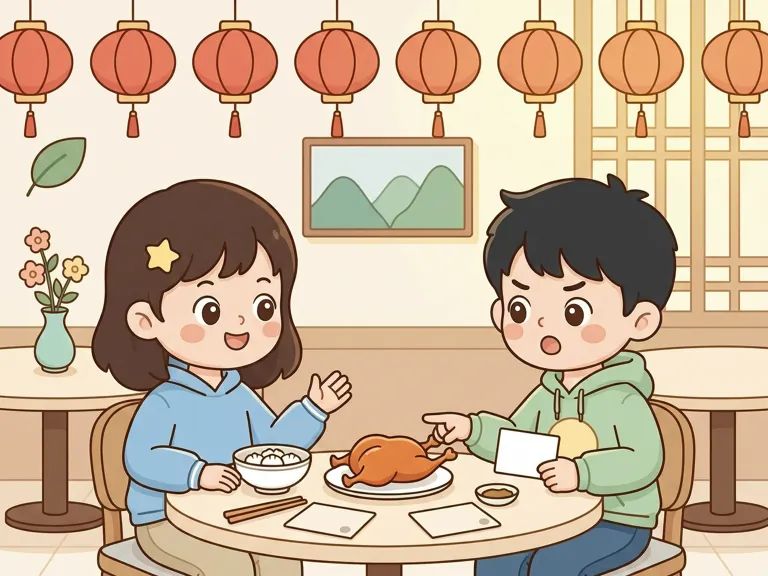
Two students in a bright restaurant looking at a blank menu and discussing dinner plans.
1

Listen and Read

Confirm who has arrived and talk about dinner plans at a restaurant entrance while practicing guesses and requests.

小林
你是小雨吧?
Nǐ shì Xiǎo Yǔ ba?
You are Xiao Yu, right?
小雨
是的。你是小林吗?
Shì de. Nǐ shì Xiǎo Lín ma?
Yes. Are you Xiao Lin?
小林
对。陈老师让我来接你。
Duì. Chén lǎo shī ràng wǒ lái jiē nǐ.
Right. Teacher Chen asked me to pick you up.
小雨
谢谢。我们请小周一起吃北京烤鸭吧。
Xiè xie. Wǒ men qǐng Xiǎo Zhōu yì qǐ chī Běijīng kǎoyā ba.
Thanks. Let’s invite Xiao Zhou to eat Peking Duck with us.
小林
好。我下午三点到学校门口,等他一起走。
Hǎo. Wǒ xiàwǔ sān diǎn dào xuéxiào ménkǒu, děng tā yìqǐ zǒu.
Good. I will be at the school gate at three in the afternoon and wait to leave with him.
2

Core Words

These words support the dialogue, grammar, and practice in this lesson.

qǐng
to invite; please
ràng
to ask someone to do something
jiào
to call; to ask
jiē
to pick someone up
帮忙
bāng máng
to help
介绍
jiè shào
to introduce
3

Core Words

Recognize these for context; they are not the main practice focus.

北京烤鸭
Běijīng kǎoyā
Peking Duck
不好意思
bù hǎo yì si
sorry; excuse me
4

Learning Note

Use `帮忙` with `请`, as in `我请朋友帮忙`. Use `介绍` when helping people meet. `不好意思` can soften an apology before a request. This dialogue also reuses suggestion `吧`; the new focus is guess-marking `吧`.

5

Pattern: `句子 + 吧?`

句子 + 吧?

At the end of a question, `吧` can show that you are making a guess from the situation. It sounds softer than asking directly.

你是小雨吧?
Nǐ shì xiǎo yǔ ba?
You must be Xiao Yu, right?
他已经到学校了吧?
Tā yǐ jīng dào xué xiào le ba?
He has probably arrived at school, right?
6

Pattern: `A + 请/让/叫 + B + 做事`

A + 请/让/叫 + B + 做事

`请`, `让`, and `叫` can introduce what another person should do. `请` is more polite; `让` and `叫` sound more like an arrangement or request.

老师让我们明天早点儿到。
Lǎo shī ràng wǒ men míng tiān zǎo diǎnr dào.
The teacher asked us to arrive earlier tomorrow.
我请朋友帮我买票。
Wǒ qǐng péng yǒu bāng wǒ mǎi piào.
I asked a friend to help me buy tickets.
7

Recognition Note

`是...的` can emphasize when, where, or how something already happened. For this first HSK2 lesson, just recognize the pattern in short sentences.

我是坐地铁来的。
Wǒ shì zuò dì tiě lái de.
I came by subway.
他是在饭店门口等我的。
Tā shì zài fàn diàn mén kǒu děng wǒ de.
He waited for me at the restaurant entrance.
8

Quick Practice

Recognize the guessing tone of `吧`.

You see your classmate already in the classroom. Which sentence correctly means `You have arrived already, right?`

You have probably arrived, right?

9

Quick Practice

Choose the correct request or arrangement pattern with `请`, `让`, or `叫`.

Which sentence means `The teacher asked Xiao Li to come early.`

The teacher asked Xiao Li to come early.