🎓 Landing in China: A Practical Guide for International Students 2026
Everything You Need to Know · From Arrival to Daily Life · Practical Tips for International Students
Just arrived in China? This comprehensive guide covers everything you need to know - from getting a phone card and bank account to essential apps and daily life tips. Bookmark this page and refer back anytime you need help navigating life in China!
1. Before You Fly & Arrival Planning
A smooth first week in China starts before your flight. Keep your passport, visa, admission letter, school contact information, and hotel or dorm address in your hand luggage.
Online Arrival Card
Foreign students can fill in the Arrival Card online before coming to China through the National Immigration Administration (NIA) system:
You may also use the "NIA 12367" app or the WeChat/Alipay mini-program. This service is free. Avoid unofficial websites that ask for payment.
ℹ️ The old China Customs health declaration form is no longer required for normal entry and exit. If you have symptoms such as fever or are diagnosed with an infectious disease, you should still declare your health status to Customs.
Can I Arrive Before School Registration?
Yes. Once your visa is valid, you can usually enter China before the official school registration date. However:
- School registration normally cannot be completed early
- Dormitory check-in is usually not available too early
- You can stay in a hotel first and go to school on the official registration date
Can I Enter Through a Different City?
Yes. Your Chinese visa is not limited to the city where your university is located. For example, if your school is in Hangzhou, entering through Shanghai is normally fine.
💡 Plan enough transfer time if you need a domestic flight or high-speed train after international arrival. Immigration, baggage claim, and customs can take longer during peak student arrival seasons.
Do Not Overpack
China is very convenient for online shopping. Bedding, pillows, towels, toothbrushes, adapters, and daily necessities can be bought on Taobao (淘宝) or Tmall Supermarket (天猫超市), often with same-day or next-day delivery.
Bring the important things first:
- Passport and visa
- Admission letter and school documents
- Graduation certificate and original academic documents
- Passport photos
- Essential medicine for the first few days
- A small amount of RMB cash
⚠️ If you have a connecting flight or train, too much luggage can slow you down and may cause you to miss the next trip.
2. Visa & Enrollment Essentials
The first month is the most important period for your legal stay in China.

Required Documents Checklist
⚠️ 2025 Policy Update! Even Chinese language students now need to provide graduation certificates!
Essential Documents:
- ✅ Original Passport
- ✅ Graduation Certificate from your highest education level
- ⚠️ Important: As of 2025, this is required even for language program students!
- ✅ Physical Examination Record from your home country (accepted by some schools)
- ✅ Passport Photos with white background (bring 10 each of 2-inch and 1-inch sizes)
- ✅ Admission Letter
- ✅ Visa application documents such as JW201/JW202 or school-issued study documents
📢 Important Note: Some agents may not be aware of the new regulations and might tell language students they don't need graduation certificates. Always verify requirements yourself to avoid entry denial or registration failure.
X1, X2, and the 30-Day Rule
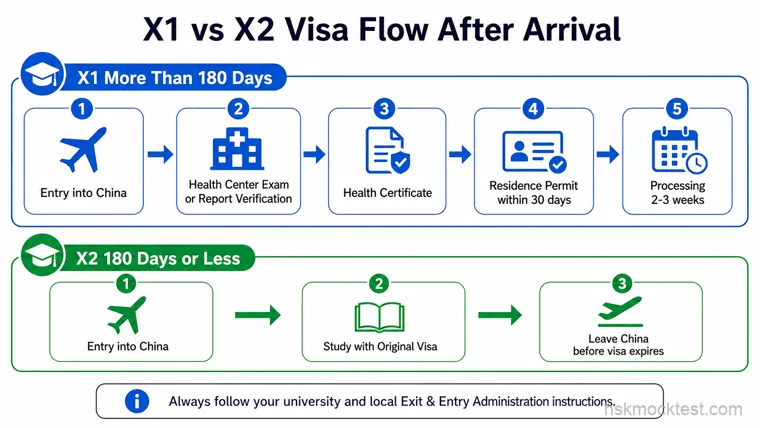
X1 visa is for long-term study. If you enter China with an X1 visa, you must apply for a Residence Permit for Study within 30 days after entry. X1 students are usually required to complete the post-arrival Foreigner Physical Examination or overseas report verification before the residence permit application, especially when applying for a residence permit valid for more than one year. Your university will usually prepare the school documents for this process after you complete registration. After the application is accepted, processing usually takes about 2-3 weeks. The official receipt will show the collection date, so keep it safe.
X2 visa is for short-term study, usually no more than 180 days. In normal cases, X2 students do not need the post-arrival Foreigner Physical Examination and do not need to change the visa into a residence permit. You study with the original X2 visa and leave China before it expires.
Official reference: NIA Residence Permit Guide
| Item | X1 Visa (More Than 180 Days) | X2 Visa (180 Days or Less) |
|---|---|---|
| Residence permit after arrival | Required | Not required |
| Deadline | Must apply within 30 days after entry | No residence permit deadline; use the original visa |
| Physical examination | Usually required before the residence permit application, or overseas report verification | Not required |
| Typical use | Degree programs or study longer than 180 days | Short-term programs, usually no more than 180 days |
Standard Name in Any City
In most cities, the standard way to describe this process is:
Visit the designated International Travel Healthcare Center (国际旅行卫生保健中心) for the Foreigner Physical Examination (外国人体格检查) or verification of your overseas Physical Examination Record for Foreigner (外国人体格检查记录).
If you already completed a physical examination abroad, the center may verify your original report. If the report does not meet local requirements, you may need to do extra tests or complete a new physical examination in China.
Physical Examination in Hangzhou
If you study in Hangzhou, students usually complete the Foreigner Physical Examination or report verification here:
| Institution | Address |
|---|---|
| Hangzhou International Travel Healthcare Center (杭州国际旅行卫生保健中心 / 杭州海关口岸门诊部) | No. 2 Wensan Road, Xihu District, Hangzhou, Zhejiang (浙江省杭州市西湖区文三路2号) |
💡 Many schools arrange group appointments or give specific instructions during registration. Check your school notice before going by yourself. Some physical examinations may require fasting.
Suggested Timeline
| Time | X1 Visa | X2 Visa |
|---|---|---|
| Before departure | Prepare original documents, photos, visa, admission letter, and online arrival card | Prepare original documents, photos, visa, admission letter, and online arrival card |
| First week | Complete school registration and follow the school's residence permit instructions | Complete school registration and study with your original X2 visa |
| First 1-2 weeks | Complete the Foreigner Physical Examination or overseas report verification as instructed by your school or local authority | No Foreigner Physical Examination |
| Within 30 days | Apply for the Residence Permit for Study at the Exit & Entry Administration | No residence permit application |
| Before visa or permit expires | Keep the receipt safe and collect your residence permit according to the receipt date | Leave China before the X2 visa expires |
⚠️ Do not wait until the last few days. Physical examination reports and school documents may take time.
✅ Pro tip: Keep all receipts and take photos of all documents as backup.
3. Housing & Temporary Accommodation
Accommodation rules are different before and after school registration.

Before Registration: Hotel Is OK
If you arrive in China before the registration date, you can stay in a hotel first. When you check in with your passport, the hotel will normally submit your temporary accommodation registration to the police system. You usually do not need to visit the police station by yourself.
💡 Before booking, confirm that the hotel can accept foreign passports. Large chain hotels are usually safer choices for first arrival.
After Registration: Follow Your University's Rules
Some universities require first-year international students to live in the dormitory. Other universities allow off-campus housing, but may require approval or registration.
Examples in Hangzhou:
| University | Common Rule |
|---|---|
| Zhejiang University | Off-campus housing may be possible if you do not reserve a dorm successfully. If your dorm reservation succeeds, dorm check-in can usually be at most 3 days before registration. |
| Zhejiang Gongshang University | International students are generally required to live in the international student apartment. Off-campus housing needs approval for special reasons. |
| Hangzhou Normal University | Degree applicants are generally expected to accept on-campus accommodation according to current admission guidance. |
⚠️ Always follow the latest notice from your own university. Do not sign a long rental contract before confirming the school rule.
If You Live Off Campus
If you rent an apartment or stay at a friend's home after registration, you usually need to complete accommodation registration within 24 hours after moving in. Your landlord, host, school, or local police station may help with the process depending on the city.
Official reference: NIA Accommodation Registration Rules
Keep these documents ready:
- Passport
- Visa or residence permit
- Rental contract or host address
- Landlord or host contact information
- School contact information
4. Getting a Phone Card
Your first priority after landing in China - stay connected with a local SIM card.
Choose Your Carrier
China has three major carriers with excellent nationwide coverage:
| Carrier | Chinese Name | Note |
|---|---|---|
| China Unicom | 中国联通 | Good Service |
| China Telecom | 中国电信 | Popular |
| China Mobile | 中国移动 | Largest |
All three offer similar service quality. Visit any nearby service center (营业厅) to get started.

Recommended Plans
Many student-friendly phone plans are around ¥29-¥39/month, but data allowance, call minutes, and student discounts vary by carrier, city, and service center. Ask the staff to show you the current packages before choosing.
Bring your passport. If you want to ask about student discounts, also bring your student ID or admission letter.
Pro Tips
💡 Request a brand new number! When visiting the service center, tell the staff: "Please give me a brand new number, never used before" (全新的号码). This helps you avoid spam messages and calls from the previous owner.
⚠️ Don't forget dorm internet! Dorm broadband (宿舍宽带) requires separate registration. Usually costs an additional ¥10/month for high-speed internet access.
5. Opening a Bank Account
Essential for daily transactions and linking to payment apps.

Recommended First Choice: MYbank (网商银行)
For most new students and workers, start with MYbank (网商银行). Opening an account is usually very fast, and you normally only need your passport. If your passport expires later, you can update the new passport information remotely, which is much easier than returning to a bank branch.
After you have lived in China for one full year under a study or work status, you can apply in the app for wealth-management access. Approval still depends on MYbank's current review rules and risk assessment.
Other Foreigner-Friendly Banks
If you prefer a traditional bank branch, these banks are confirmed to accept foreign passport holders:
| Bank | Chinese Name | Special Feature |
|---|---|---|
| Bank of China | 中国银行 | Most Accessible |
| China Merchants Bank | 招商银行 | English Service |
⚠️ Important: Not all branches accept foreign applicants. Call ahead to confirm before visiting to save yourself a wasted trip!
Documents for Branch Banks
- ✅ Passport (mandatory)
- ✅ Admission letter or work offer (proof of legal residence)
- ✅ Chinese phone number (for verification codes)
If You Need a Physical Debit Card
Class 1 Debit Card (一类储蓄卡) - If you open an account at a traditional branch, this is the standard, full-featured account you need. It supports:
- Linking to Alipay (支付宝) and WeChat Pay (微信支付)
- ATM withdrawals and transfers
- Online shopping and bill payments
- Higher limits than restricted account types
💡 Heads up: Banks and payment platforms may still apply daily limits or risk-control checks. Some banks may also require an initial deposit or additional verification.
6. Setting Up Alipay
Critical setup steps for seamless shopping and payments.
Must-Do After Arriving in China
ℹ️ Link Your Chinese Phone Number! If you registered Alipay (支付宝) with an email address before coming to China, basic features will work. However, you'll encounter issues when shopping on Taobao (淘宝):
⚠️ Common Problem: The system often fails to recognize your Alipay (支付宝) account automatically, causing payment failures or redirect errors when checking out on Taobao (淘宝).
Solution: Complete Your Profile
-
Navigate to Settings
- Open Alipay → "Me" (我的) → "Settings" (设置) → "Account & Security" (账号与安全)
-
Link Phone & Verify Identity
- Add your Chinese number and complete real-name verification using your passport
-
Add Payment Method
- Link your Chinese bank card or an international credit/debit card
- After your account is set up, a friend can also transfer a small amount of RMB to your Alipay balance if needed
✅ Result: After completing these steps, you'll enjoy seamless one-click payments on Taobao (淘宝), Tmall (天猫), Taobao Flash Delivery (淘宝闪购), and other platforms with automatic Alipay (支付宝) login!

7. Getting Around
Navigate China's cities with ease - no wallet needed!
Metro & Bus Transit
- Open Alipay (支付宝)
- Tap "Travel" (出行) on homepage
- Activate "Transit QR Code" (公交码/地铁码)
- Scan to enter/exit stations
✅ Super convenient! No need to buy tickets - automatic fare deduction. Supported in almost every city across China!
Bike Sharing - Perfect for Short Trips
Want to explore campus or the city freely? Bike sharing is your best option!
| Brand | Chinese Name | Color | How to Use | Foreigner-Friendly |
|---|---|---|---|---|
| Hellobike | 哈罗单车 | 🔵 Blue | Open Alipay → Scan QR code | ✅ Yes - Passport verification accepted |
| Meituan Bike | 美团单车 | 🟡 Yellow | Open Meituan App → Scan to ride | ✅ Yes - Phone number required |
| Qingju | 青桔单车 | 🟢 Green | Requires Didi App | ❌ No - Chinese ID card required |
🌟 Recommended: Hellobike (哈罗单车) Easiest to use via Alipay (支付宝), widest coverage, and most foreigner-friendly!

💡 First-time tips:
- Pay a deposit or link your Sesame Credit (芝麻信用) for deposit-free rides
- Always check brakes and tires before riding
- Park in designated areas to avoid fines
8. Money & Living Costs
China is highly mobile-payment based, but it is still smart to carry a small amount of cash for your first day, especially for airport food, taxis, or unexpected payment problems.
Cash at Entry
For normal student arrival, do not carry too much cash.
| Cash Type | Practical Reminder |
|---|---|
| RMB cash | Keep it below ¥20,000 when entering or leaving China |
| Foreign currency cash | If it is equivalent to US$5,000 or more, declare it to Customs |
Official reference: Customs Clearance Guide for Inbound Passengers
💡 A practical starting amount is usually ¥500-¥2,000 in cash, plus Alipay or an international card. Most daily payments in China are made through Alipay (支付宝) or WeChat Pay (微信支付).
Rough Monthly Living Costs
These estimates do not include tuition. Dormitory fees and private rent vary a lot by city and university.
| City Type | Simple Meal | Basic Monthly Spending |
|---|---|---|
| Beijing / Shanghai | ¥18-¥35 | ¥2,500-¥4,500+ |
| Hangzhou | ¥15-¥25 | ¥2,000-¥3,500 |
| Other major cities | ¥12-¥25 | ¥1,500-¥3,000 |
Typical student spending includes:
- Food: campus canteen meals are usually cheaper than restaurants
- Transportation: metro, bus, and shared bikes are affordable
- Phone plan: often around ¥29-¥39/month
- Daily supplies: cheaper if bought online
- Social life and travel: depends heavily on your lifestyle
Basic Chinese Helps a Lot
Many shop owners, drivers, and service staff may not speak English. Learn a few basic phrases and keep your address saved in Chinese.
For taxi or ride-hailing:
- Use Gaode Map (高德地图) or Didi (滴滴)
- Show the driver the destination in Chinese
- Save your school address, dorm address, and hotel address in advance
9. Healthcare & Medicine
Stay healthy and know where to get help when you need it.
Buying Medicine
For Regular Medications
Cold medicine, fever reducers, band-aids, etc.
Recommended: Ali Health Pharmacy (阿里健康大药房) on Taobao (淘宝)
- Official Alibaba-operated pharmacy
- Guaranteed quality and authenticity
- Delivery in 1-2 days
Need Medicine Urgently?
Open Taobao Flash Delivery (淘宝闪购) or Meituan (美团) delivery app:
- Search for "pharmacy" (药店) or "medicine" (买药)
- Select a nearby pharmacy
- Place your order
- Delivery in as fast as 1 hour to your door! 🚴♂️
✅ This saved me during a midnight fever emergency!

Seeing a Doctor
⚠️ Important: Foreigners typically cannot book hospital appointments directly through apps (like Alipay (支付宝) or WeChat (微信) hospital services).
How to Get Medical Care
Option 1: Call the Hospital
- Ask about international clinics or English-speaking services
Option 2: Walk-in Registration
- Go directly to the hospital for on-site registration (bring your passport!)
💡 Pro tip: Research top-tier hospitals (三甲医院) near your school in advance and save their contact numbers. These hospitals have the best facilities and are more likely to have English-speaking staff.
10. Essential Apps
These apps are absolutely essential - you'll use them every single day!

⚠️ Important: Google Play and Apple App Store don't work well in mainland China! You'll need to switch to the China region to download these apps.
How to Download Chinese Apps
Android Users: Tencent App Store (腾讯应用宝)
iPhone Users: Switch your Apple ID to China region
Payment & Communication
Alipay (支付宝) 💛
China's "super wallet" - absolutely essential!
- ✅ Link Chinese bank cards or Visa/Mastercard international cards
- ✅ Buy bubble tea, ride metro, book hotels, pay utilities - everything!
- ✅ Cash is often inconvenient because many places cannot make change easily - Alipay = peace of mind
WeChat (微信) 💙
More than just messaging - it's your social lifeline!
- ✅ Messaging, voice/video calls, group chats
- ✅ Scan to order at restaurants, pay bills, call taxis, book tickets
- ✅ Nearly everyone in China uses it - not having it means you're "offline" 😅
Transportation & Navigation
Gaode Map (高德地图) 🗺️
More accurate than Baidu Maps with frequent updates!
- ✅ Check bus/metro routes, walking navigation, taxi fare estimates
- ✅ Built-in taxi calling feature for seamless rides
Didi (滴滴) 🚖
China's "Uber" - the go-to ride-hailing app!
- ✅ Enter destination, get matched with a driver automatically
- ✅ Pay with Alipay (支付宝) or WeChat Pay (微信支付)
Shopping & Lifestyle
Taobao (淘宝) + Tmall Supermarket (天猫超市) 📦
Shop till you drop - everything you need!
- ✅ Daily necessities, clothes, electronics - you name it
- ✅ Forgot your blanket? No toothbrush?
- 👉 Open Tmall Supermarket (天猫超市), select "same-day delivery" (半日达), get it in 2 hours!
Xianyu (咸鱼) 🚴♂️
Second-hand marketplace - perfect for students!
- ✅ Buy used bikes, lamps, chairs, appliances - cheap and eco-friendly
- ✅ Sell your unused items for extra cash 💰
Food Delivery & Groceries
Taobao Flash Delivery (淘宝闪购) / Meituan (美团) 🍜
Don't feel like going out? Order delivery!
- ✅ Thousands of restaurants - from spicy hotpot to pizza and burgers
- ✅ Average delivery time: 15-30 minutes, often cheaper than dining in!
Xiaoxiang Supermarket (小象超市) / Freshippo (盒马) 🛒
Fresh groceries delivered to your door!
- ✅ Fruits, milk, snacks, daily necessities - delivered within 1 hour!
- ✅ Freshippo (盒马) also offers fresh-made meals, bakery items, and sushi!
Travel & Social
Ctrip (携程) / Fliggy (飞猪) 🎫
One-stop shop for all your travel needs!
- ✅ Book flights, trains, hotels, attraction tickets
- ✅ Available in Chinese and English
- ✅ Fliggy (飞猪) guarantees lowest hotel prices with price-match refunds!
Xiaohongshu (小红书) 📸
China's "Instagram + Pinterest"
- ✅ Share food, travel, fashion, study tips
- ✅ Search "international student life" (留学生日常) or "city guides" (城市攻略) for useful tips!
- ✅ I found the best hotpot near my school through this app! 🔥
Learning & Productivity
Qwen (千问) / Doubao (豆包) / DeepSeek 🤖
Chinese AI assistants!
- ✅ Help with homework, research, translation, proofreading
- ✅ Highly recommend Qwen (千问) - one of China's most powerful AIs, great for translation and language learning!
WeChat Read (微信阅读) / Ximalaya (喜马拉雅) / Xiaoyuzhou (小宇宙) 📖🎧
- WeChat Read (微信阅读): Affordable e-books, huge selection
- Ximalaya (喜马拉雅): Chinese podcasts and audiobooks
- Xiaoyuzhou (小宇宙): Popular Chinese podcast platform for young people
Baidu Netdisk (百度网盘) / Quark (夸克) 🌐
Like Google Drive or Dropbox
- ✅ Store files, share materials
- ✅ Essential for school and work!
11. Quick FAQ
Can I stay in a hotel before school registration?
Yes. Hotels normally complete temporary accommodation registration with your passport.
Can I live outside the dormitory?
It depends on your university. Confirm with your school before signing a rental contract.
If I already had a physical examination abroad, do I still need one in China?
Possibly yes. If you need a long-term residence permit, follow your university's instructions for local examination or report verification.
Do one-semester language students need the Foreigner Physical Examination?
Usually no for X2 students staying 180 days or less, unless your school gives different instructions.
Can I enter China through Shanghai if my school is in Hangzhou?
Yes. This is normally allowed. Leave enough transfer time.
How much cash should I bring?
Bring a small amount for arrival, such as ¥500-¥2,000. Keep RMB cash below ¥20,000, and declare foreign currency cash if it is equivalent to US$5,000 or more.
Can I work part-time as an international student?
Do not work privately without permission. Work-study or internship activities usually require university approval and may require an annotation on your residence permit.
What if I cannot speak Chinese yet?
Learn basic phrases before arrival and save important addresses in Chinese. For taxis, show the driver your destination in Gaode Map (高德地图) or Didi (滴滴).
🎉 You've Got This!
The first week is mostly about documents, phone access, payment setup, and finding your way around campus.
Once these basics are handled, daily life in China becomes much easier.
Tags: #ChinaLifeGuide #LivingInChina #InternationalStudents #Alipay #WeChat #GaodeMap #ChinaTravel #VisaGuide #StudentLife #BikeSharingChina