HSK 3

Lesson 18 · 我学会了包饺子

What you'll learn

Describe Spring Festival experiences and personal growth with approximate numbers, `刚才/刚刚`, `只要...就...`, and `从...起`.
About 38 min
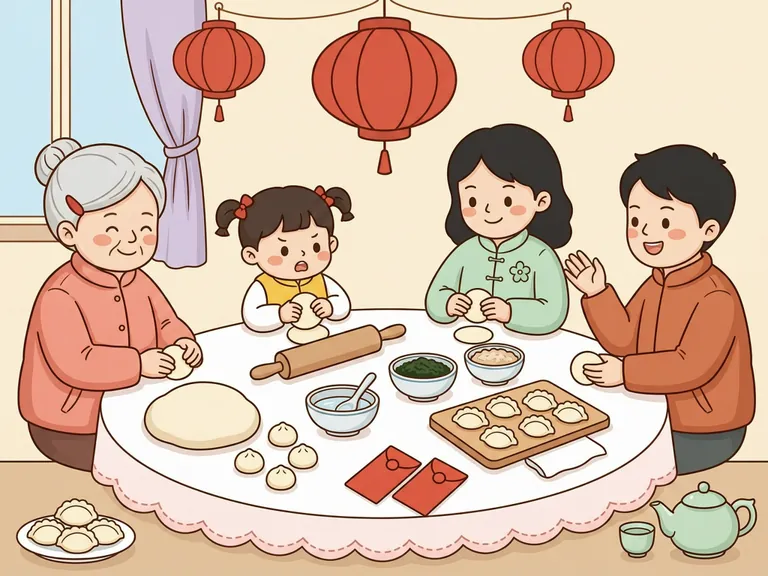
A cute cartoon Spring Festival home scene with learners making dumplings at a table and blank red envelopes.
1

Listen and Read

Talk about Spring Festival, learning to make jiaozi, and long-term effort.

小雨
我第一次在中国过春节,开心极了。
Wǒ dì yī cì zài Zhōngguó guò Chūnjié, kāi xīn jí le.
It is my first time celebrating Spring Festival in China, and I am extremely happy.
小林
春节的时候,我们家常常一边聊天一边包饺子。
Chūnjié de shí hou, wǒ men jiā cháng cháng yì biān liáotiānr yì biān bāo jiǎo zi.
During Spring Festival, my family often chats while making jiaozi.
小雨
我刚刚洗完手,可以一起包饺子吗?
Wǒ gāng gāng xǐ wán shǒu, kě yǐ yì qǐ bāo jiǎo zi ma?
I just finished washing my hands. Can we make jiaozi together?
小林
只要你愿意练,就会越包越好。
Zhǐ yào nǐ yuàn yì liàn, jiù huì yuè bāo yuè hǎo.
As long as you are willing to practice, you will make them better and better.
小雨
从今天起,我想了解更多中国节日。
Cóng jīn tiān qǐ, wǒ xiǎng liǎo jiě gèng duō Zhōngguó jié rì.
Starting today, I want to learn more about Chinese festivals.
2

Core Words

Practice the words that carry this lesson's dialogue, patterns, and final question.

春节
Chūnjié
Spring Festival
包饺子
bāo jiǎo zi
to make jiaozi
刚才
gāng cái
just now
刚刚
gāng gāng
just; recently
3

Pattern: Approximate Numbers

neighboring numbers together

Two neighboring numbers together can show an approximate quantity.

周末大概休息两三天。
Zhōu mò dà gài xiū xi liǎng sān tiān.
The weekend break is about two or three days.
桌上有两三杯茶。
Zhuō shang yǒu liǎng sān bēi chá.
There are two or three cups of tea on the table.
4

Pattern: `刚才` vs `刚刚`

刚才 + event / subject + 刚刚 + verb

`刚才` is usually a time noun meaning a few moments ago. `刚刚` is an adverb before the verb and can cover a recent event.

刚才的菜是爸爸做的。
Gāng cái de cài shì bà ba zuò de.
The dish from just now was made by Dad.
我刚刚包好了一盘饺子。
Wǒ gāng gāng bāo hǎo le yì pán jiǎo zi.
I just finished making a plate of jiaozi.
5

Pattern: `只要...就...`

只要 + sufficient condition,就 + result

`只要...就...` says that one sufficient condition will bring the result.

只要你每天练,就能学会包饺子。
Zhǐ yào nǐ měi tiān liàn, jiù néng xué huì bāo jiǎo zi.
As long as you practice every day, you can learn to make jiaozi.
只要大家愿意,我就多做一点儿菜。
Zhǐ yào dà jiā yuàn yì, wǒ jiù duō zuò yì diǎnr cài.
As long as everyone wants it, I will make a little more food.
6

Pattern: `从...起`

从 + time + 起

`从...起` marks when a new habit, plan, or change starts.

从今天起,我每天练习中文。
Cóng jīn tiān qǐ, wǒ měi tiān liàn xí Zhōngwén.
Starting today, I will practice Chinese every day.
从那天起,他开始了解中国节日。
Cóng nà tiān qǐ, tā kāi shǐ liǎo jiě Zhōngguó jié rì.
Starting from that day, he began to learn about Chinese festivals.
7

Learning Note

`从...起` marks a starting point.

`从今天起` means “starting today.” It is useful when talking about new habits, goals, or changes.

8

Practice

Choose the sufficient-condition sentence.

Daily practice is enough to learn how to make jiaozi.

Which sentence uses `只要...就...` correctly?

9

Practice

Choose the starting-point sentence.

Starting today, you want to practice Chinese every day.

Which sentence uses `从...起` correctly?